
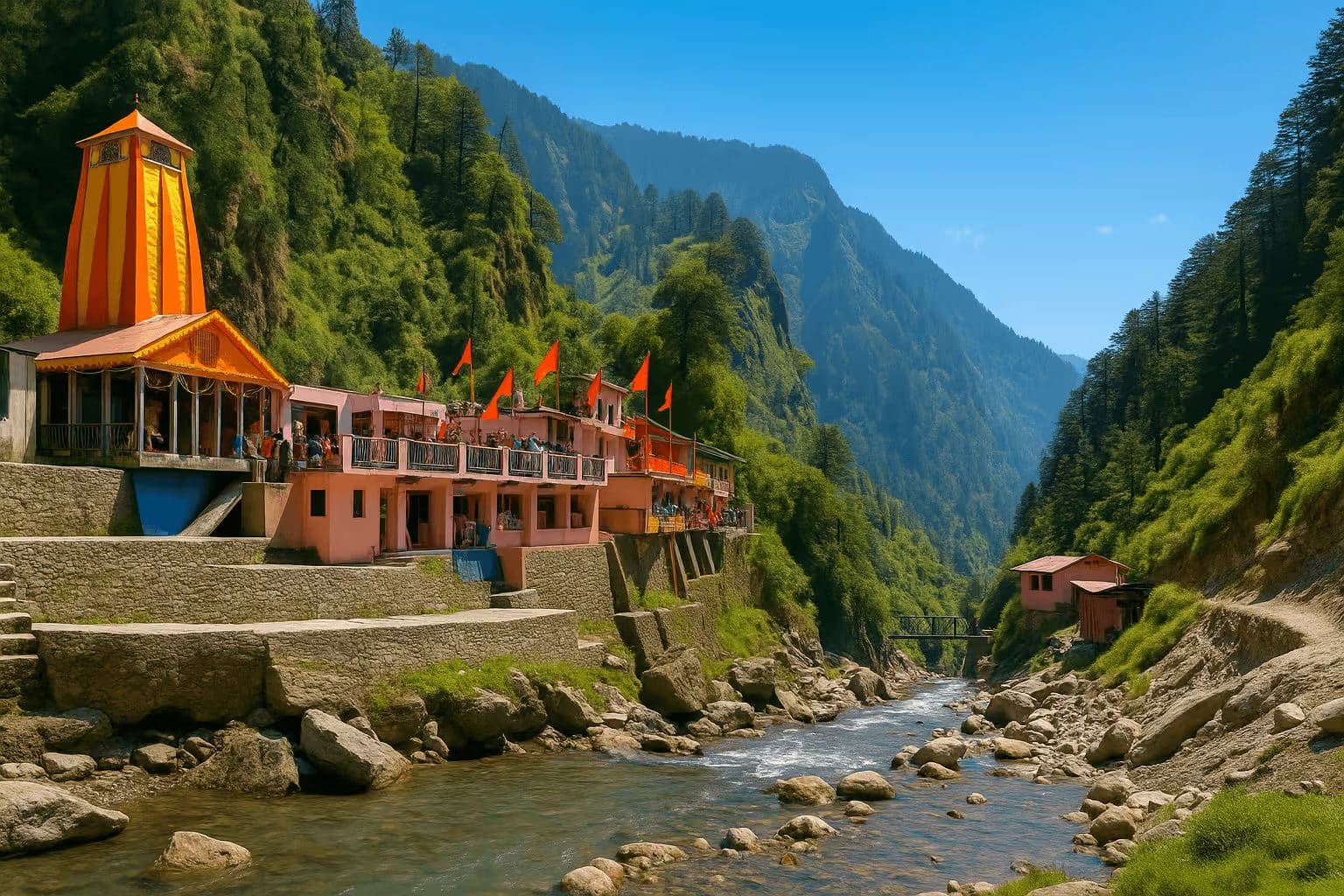
Of every journey I have planned in thirty years in this business, the Char Dham Yatra is the one that draws the widest range of travellers, from lifelong pilgrims who have waited decades for the trip, to younger travellers drawn purely by the scenery and the physical challenge. Both groups tend to make the same planning mistakes, because most of the information available online is either purely devotional in tone or purely logistical, rarely both. This guide is meant to fix that.
What Is the Char Dham Yatra?
The Char Dham Yatra is a pilgrimage circuit through four sacred Himalayan shrines in Uttarakhand: Yamunotri, Gangotri, Kedarnath, and Badrinath. Together, they represent the sources of two of India's most sacred rivers and two of its most revered temples, all sitting between roughly 10,000 and 12,000 feet in the Garhwal Himalayas. The traditional order follows a west-to-east loop, beginning at Yamunotri and ending at Badrinath, though some operators run it in reverse depending on road conditions that season.
Unlike a typical sightseeing itinerary, this is as much a physical undertaking as a spiritual one. Sections of the route to Kedarnath and Yamunotri require walking or pony/palanquin transport over mountain trails, and altitude is a real factor that deserves proper respect, not just enthusiasm.
The Char Dham Yatra Route, Stage by Stage
Yamunotri: The starting point for most itineraries, reached via a trek of roughly five to six kilometres from Janki Chatti, either on foot, by pony, or by palanquin for those unable to walk the distance. The temple sits near the source of the Yamuna River, alongside hot springs where pilgrims traditionally cook rice as an offering.
Gangotri: Unlike Yamunotri, Gangotri is accessible by road directly to the temple, making it the most straightforward of the four stops. It marks the point where the Ganges, worshipped as Ganga, is believed to descend to earth.
Kedarnath: The most physically demanding stop on the circuit, requiring a trek of around sixteen to eighteen kilometres from Gaurikund, or a helicopter transfer for those short on time or unable to manage the trek. This is also the site most associated with the devastating 2013 floods, and the temple's survival amid that disaster has only deepened its spiritual significance for many pilgrims.
Badrinath: The final stop, accessible by road, dedicated to Lord Vishnu and sitting near the Tibetan border in one of the most dramatic mountain settings on the entire circuit.
Best Time for the Char Dham Yatra
The Char Dham Yatra operates on a strict seasonal window because the temples are located in high-altitude terrain that becomes impassable in winter. The shrines typically open between late April and mid-May each year, following a ceremony that varies slightly by year based on the Hindu calendar, and close again around late October or Diwali, when the deities are ceremonially moved to their winter locations at lower altitudes.
May and June see the highest footfall, coinciding with school holidays and pleasant weather before the monsoon arrives. July and August bring monsoon rains and a real risk of landslides on mountain roads, and I generally advise clients to avoid this window unless flexibility is built into the schedule. September and early October offer a quieter, often better window, with clearer skies and thinner crowds than the peak May-June rush.
Char Dham Yatra Registration: What You Actually Need to Know
This is the single area where I see the most confusion, and it has become significantly more structured in recent years following crowd-management measures introduced by the Uttarakhand government.
Online registration is mandatory for all four shrines and must be completed before travel, either through the official Uttarakhand Tourism registration portal or through a registered tour operator who handles it on your behalf. Registration typically requires basic identification documents and, in recent years, a medical fitness declaration given the altitude and physical demands involved.
Biometric registration is also required at designated checkpoints along the route for the Kedarnath leg specifically, given the trek involved.
My honest advice: unless you are experienced with Indian government portals and comfortable navigating them in real time during peak season when servers slow under demand, this is worth delegating to an operator who handles registration as a standard part of the package. The cost of getting this wrong is a wasted day or, in worse cases, being turned back at a checkpoint.
What to Pack for the Char Dham Yatra
Given the altitude and the trekking involved, packing correctly matters more here than on almost any other Indian itinerary.
Layered clothing is essential. Daytime temperatures at these altitudes can feel pleasant in direct sun, but temperatures drop sharply after dark and at higher points like Kedarnath and Badrinath. Thermal base layers, a fleece or down layer, and a waterproof outer shell cover most conditions.
Sturdy trekking shoes, broken in well before the trip, are non-negotiable for the Kedarnath and Yamunotri legs. This is not a trip to test new footwear on.
Rain protection, including a poncho and a waterproof cover for your bag, given how quickly weather changes at altitude, particularly outside the May-June window.
Basic altitude medication, discussed in advance with a doctor, along with any personal medication carried in adequate supply, since pharmacy access along the route is limited.
A physically comfortable daypack rather than a large suitcase, since a significant portion of the journey involves walking or riding, not driving directly to each site.
Physical Preparation for the Char Dham Yatra
I say this to every client considering this trip, regardless of age or fitness level: do not underestimate the Kedarnath trek. Sixteen kilometres at altitude is a genuinely demanding undertaking, even for reasonably fit travellers, and altitude sickness does not discriminate by age or general fitness. A few weeks of walking practice beforehand, staying well hydrated throughout the trip, and a willingness to pace yourself rather than rush to keep up with a group all make a meaningful difference.
For travellers unable or unwilling to attempt the trek, helicopter services operate to Kedarnath during the season, though these should be booked well in advance given limited daily capacity and high demand.
Final Thoughts
The Char Dham Yatra is unlike any other journey in this guide, not because it is more beautiful than Kashmir or more culturally rich than Rajasthan, but because it asks something of the traveller in return. The registration process, the altitude, the physical demand of the trek, all of it is part of what makes the arrival at each shrine feel earned rather than simply visited.
At Paryatan, we handle the registration, the permits, and the logistics that trip up so many independent travellers, so that your energy goes toward the journey itself rather than the paperwork around it. If you are considering the Char Dham Yatra for this season, our travel desk can walk you through exactly what your specific route and dates will require.
Frequently Asked Questions
When does the Char Dham Yatra open each year?
The shrines typically open between late April and mid-May, based on an annual ceremony tied to the Hindu calendar, and close again around late October.
Is registration mandatory for the Char Dham Yatra?
Yes, online registration is mandatory for all four shrines and should be completed before travel, either independently through the official portal or through a registered operator.
Can I skip the trek to Kedarnath?
Helicopter services operate to Kedarnath during the season as an alternative to the sixteen-kilometre trek, though slots should be booked well in advance.
What is the best month to do the Char Dham Yatra?
May, June, September, and early October generally offer the best conditions, while July and August carry higher risk of monsoon-related road disruption.
Is the Char Dham Yatra suitable for elderly travellers?
It can be, particularly with palanquin, pony, or helicopter options for the more demanding legs, but a medical consultation beforehand is strongly recommended given the altitude involved.
Keep reading
Destination Guides
Kashmir Tour Package: Best Places to Visit in Srinagar, Gulmarg & Pahalgam
Travel Planning
Golden Triangle Tour Itinerary: 3-Day vs 5-Day vs 7-Day Options Compared
Travel Planning
How Much Does a Kerala Backwaters Houseboat Trip Cost? Full Pricing Breakdown
Travel Planning
The Complete India Travel Guide: How to Plan Your First Trip to Incredible India
Destination Guides
The Best Time to Visit Kashmir — A Season-by-Season Guide