
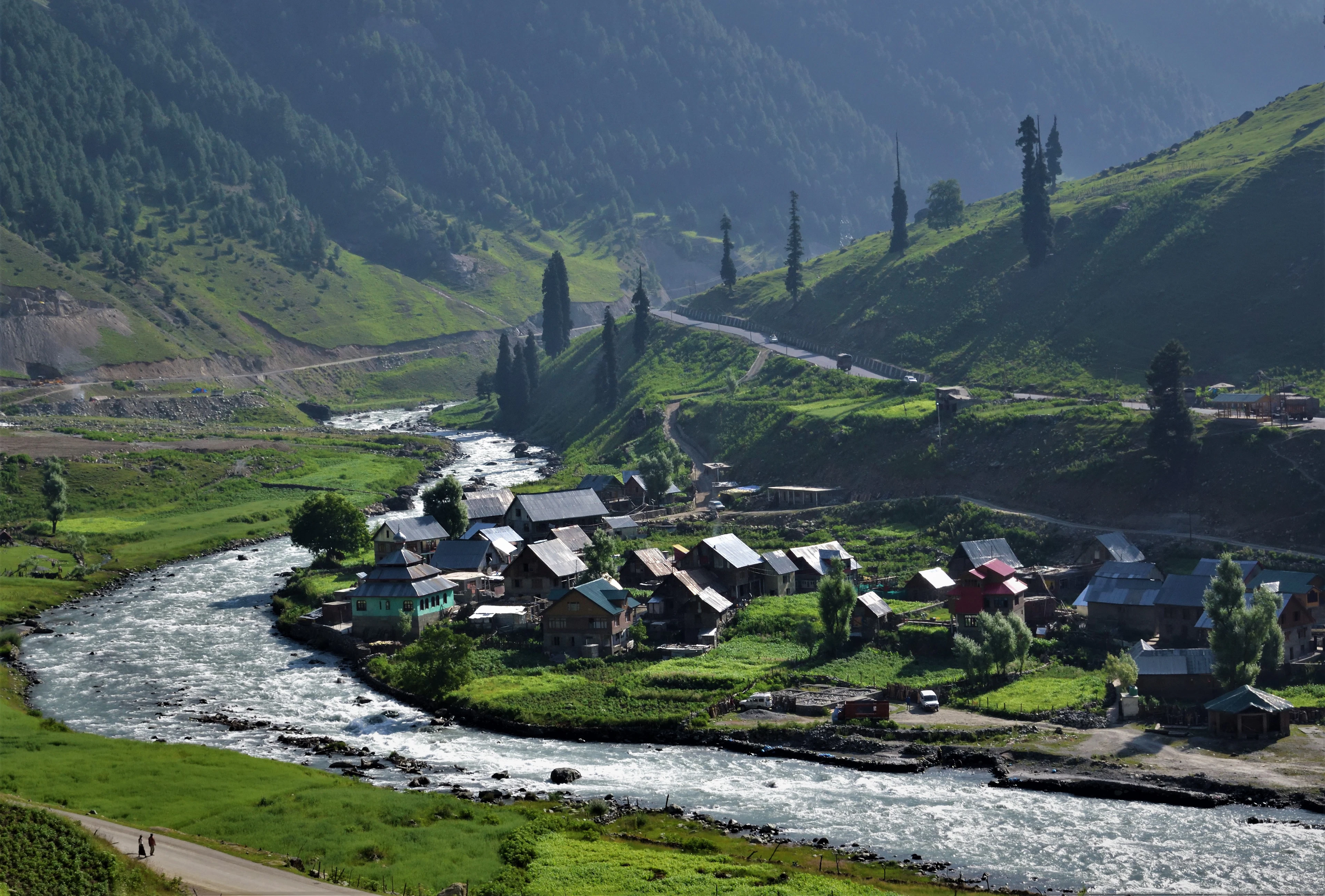
Almost every Kashmir itinerary looks identical on paper — Srinagar, Gulmarg, Pahalgam, Sonamarg. What changes wildly is the month you go. The same four places deliver a snowbound ski trip in January, a meadow of tulips in April, and an escape from 45°C plains heat in June.
So the useful question is not "when is the best time to visit Kashmir". It is "what do you want Kashmir to be". This guide answers that season by season, including the honest downsides of each — the ones that rarely make it into brochures.
Spring: March to early May
Spring is the season most people mean when they picture Kashmir. Almond and cherry blossom arrive in late March, the Mughal Gardens reopen properly, and the valley floor turns green while the peaks are still white — the contrast that makes Kashmir photograph the way it does.
The headline event is the Indira Gandhi Memorial Tulip Garden below the Zabarwan hills. At roughly 30 hectares across seven terraces, it is Asia's largest tulip garden, planted with around 1.8 million bulbs across 70-plus varieties. It opens for a short window — typically mid-March to mid-April — and 2026 opened unusually early on 16 March, with peak bloom in the first week of April.
- Best for: blossom, tulips, green valleys with snow still on the peaks
- Daytime temperature: roughly 15–22°C, cold evenings
- Watch out for: the tulip window is genuinely short and shifts with the weather each year
If tulips are the reason you are going, do not book on last year's dates. The garden opens on the season, not the calendar — confirm before you commit to flights.
Summer: May to August
This is peak season, and for good reason. While much of northern India sits at 40°C and above, Srinagar hovers in the mid-20s to low-30s. Every high-altitude road is open, including Sonamarg and the routes beyond it, and the meadows at Pahalgam and Gulmarg are at their greenest.
It is also the easiest season to travel in. Nothing is weather-dependent, the Gulmarg gondola runs both phases reliably, and shikara evenings on Dal Lake are genuinely pleasant rather than something you endure in a coat.
The trade-off is everyone else. Hotel rates on the Dal Lake houseboats and in Pahalgam climb steeply from late May, and the popular viewpoints get busy by mid-morning. If you are travelling in July or August, also expect the Amarnath Yatra to affect traffic and accommodation on the Pahalgam and Sonamarg routes.
- Best for: first-time visitors, families, anyone escaping the plains heat
- Daytime temperature: roughly 24–31°C
- Watch out for: highest prices of the year, and Yatra-season congestion in July–August
Autumn: September to November
Ask people who have been to Kashmir several times which season they would go back for, and a surprising number say autumn. The chinar trees turn deep red and gold through October and early November, the summer crowds have gone, the light is low and clean, and prices drop noticeably from the June peak.
The air is crisp rather than cold for most of this window, and the valley has a settled, unhurried feel. The main constraint is that it gets dark early and the high passes begin closing towards the end of November.
- Best for: photography, couples, travellers who dislike crowds
- Daytime temperature: roughly 10–23°C, dropping through the season
- Watch out for: shorter daylight hours, and some higher routes closing from late November
Autumn is the best value window of the year. You get most of summer's access at a meaningful discount, and the chinars in mid-October are the single most underrated sight in the valley.
Winter: December to February
Winter turns Kashmir into a different country. Snow is reliable from late November through early April, and the deepest, most consistent cover falls during Chillai-Kalan, the 40-day core of winter running from 21 December to 29 January.
Gulmarg is the draw. The gondola climbs in two stages — Phase 1 to Kongdoori at around 8,500 ft, Phase 2 to Apharwat Peak at close to 13,000 ft — and the skiing off Apharwat is the reason Gulmarg has an international reputation rather than merely a domestic one. January and February are the prime months, when the base is deepest.
Be realistic about the conditions. Heavy snowfall closes the Srinagar–Gulmarg road at times, Phase 2 of the gondola shuts in high wind, and the Jammu–Srinagar highway can be blocked for a day or more. Winter Kashmir rewards a flexible itinerary and punishes a tight one.
- Best for: snow, skiing and snowboarding, honeymooners who want the postcard
- Daytime temperature: roughly -2 to 8°C, well below freezing at night
- Watch out for: road and gondola closures — build a buffer day into any winter trip
So which month should you actually book?
If you want one answer: late September to late October. Autumn gives you full access to every valley, comfortable daytime weather, the chinars at their best, thinner crowds and lower rates than summer. It is the season that asks least of you and gives most back.
If tulips are non-negotiable, you are looking at a two-to-three week window from mid-March. If snow is the point, aim for late January or February and accept that a day may be lost to weather. If you are travelling with children or older parents in the school holidays, summer is worth the premium for the sheer reliability of it.
Once you have picked your window, our guide to the best places to visit in Srinagar, Gulmarg and Pahalgam covers what to see and how many nights to allow. If Kashmir is one stop on a wider trip, the first-time India travel guide shows where it fits alongside the other classic circuits.
A few things worth knowing whenever you go
Kashmir rewards slow travel. The distances look short and the drives take longer than the map suggests — Srinagar to Pahalgam is around 90 km and a comfortable half-day with stops.
- Book Gulmarg gondola tickets in advance in peak season; same-day availability is unreliable and tatkal tickets cost substantially more
- Spend at least one night on a Dal Lake houseboat rather than treating it as a daytime photo stop
- Carry layers in every season — evenings are cold even in July, and the temperature drops sharply when the sun goes behind the ridge
- Mobile connectivity is patchier once you leave Srinagar; download offline maps before you travel
Keep reading
Destination Guides
Kashmir Tour Package: Best Places to Visit in Srinagar, Gulmarg & Pahalgam
Destination Guides
Char Dham Yatra Guide: Route, Registration, Best Time & What to Pack
Travel Planning
Golden Triangle Tour Itinerary: 3-Day vs 5-Day vs 7-Day Options Compared
Travel Planning
How Much Does a Kerala Backwaters Houseboat Trip Cost? Full Pricing Breakdown
Travel Planning
The Complete India Travel Guide: How to Plan Your First Trip to Incredible India